Why do children need STEM games, not just yoys?
24.06.2026
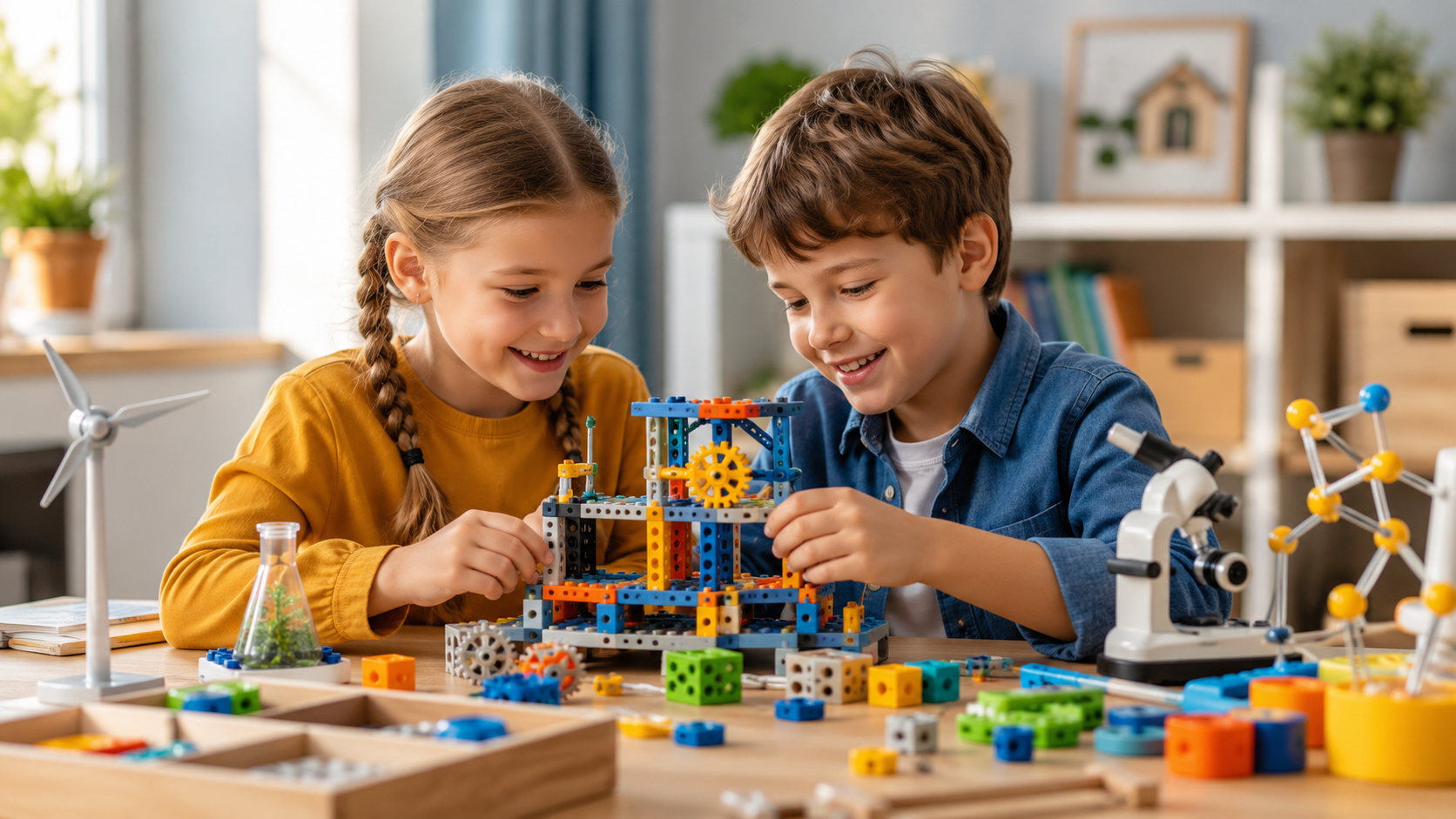
Play is one of the most natural ways for children to explore the world. However, not all toys offer the same benefit. Some only entertain, while others help children think, explore, compare, make mistakes and find solutions. That is why STEM games, construction sets and experiment kits hold a special place – they help children discover science, technology, engineering and mathematics.
What Does a STEM Game Teach a Child — and What Do We Often Miss?
A STEM game is not just a “smart toy” for a child. It is a small discovery laboratory. When a child builds a tower, puts together a puzzle, connects magnets or tests how a simple mechanism works, they are training logical thinking, patience, spatial awareness and the ability to understand cause and effect. When a construction falls apart, the child learns not to give up, but to ask: “Why did that happen?” and “What can I do differently?”
Research shows that children absorb science and mathematics ideas not only at school, but also in everyday situations: at home, in museums, through play, hands-on activities and conversations with adults (Link to the study). This is why the games and activities parents choose play an important role in a child’s cognitive development.
Tasks like these engage not only sight and hearing, but also kinaesthetic memory. This means the child learns with their whole body.
STEM games are particularly effective at developing spatial thinking. Blocks, puzzles, shapes, gears and construction sets help children understand size, direction, symmetry, stability and distance. These skills later become important in mathematics, geometry, programming and engineering. Research highlights that play with blocks, puzzles and shapes supports early spatial skills, which are closely linked to readiness for STEM learning (Link to the study).
What Does a Child Take Away from a STEM Game?
STEM games do not turn a child into a scientist in a single day. But they help shape a child who is not afraid to try, think, question and seek solutions. And these skills will serve a child far longer than the toy itself.