What happens in the brain when kids do mental math?
13.07.2025
We often think of mental math as “simple calculation without a calculator.”
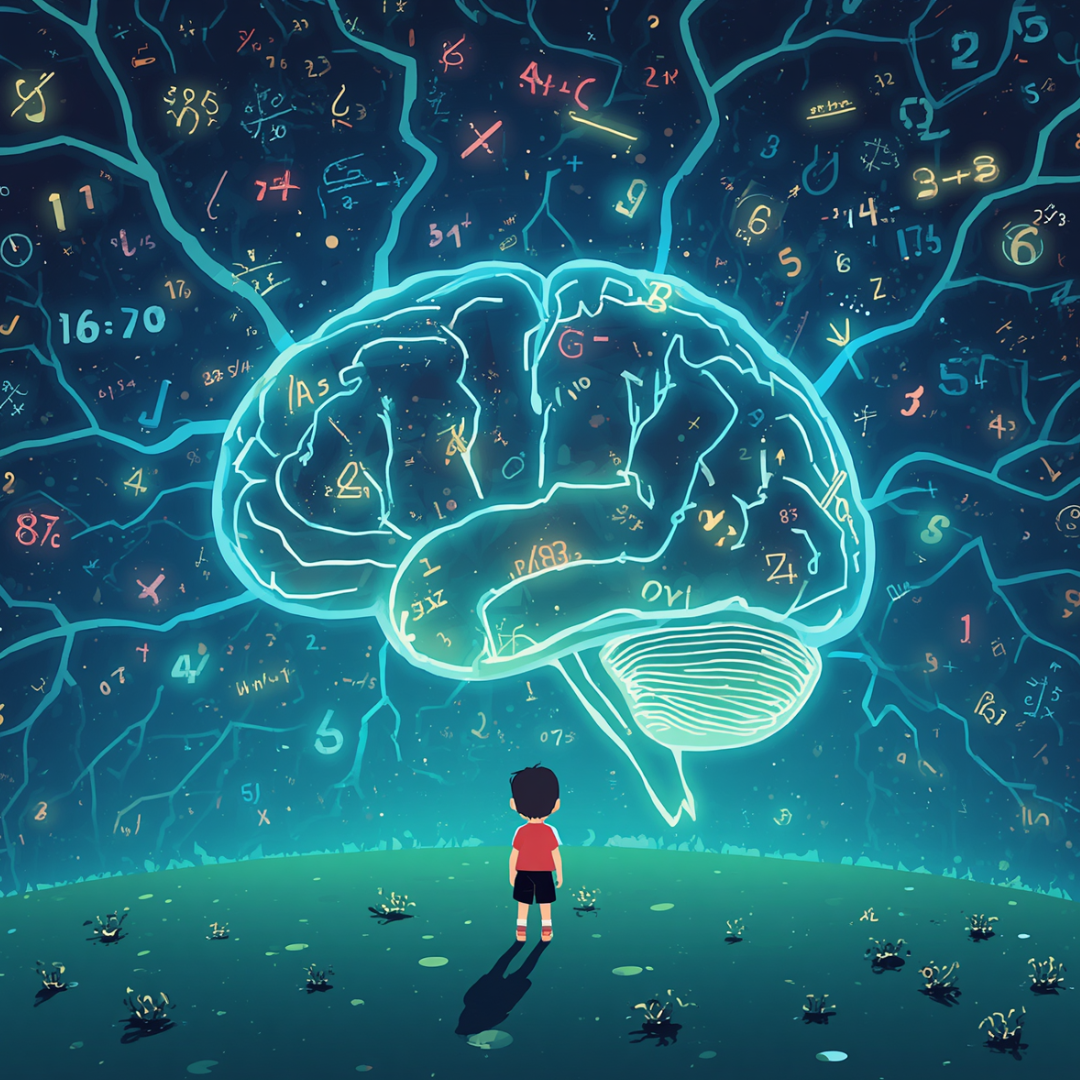
However, scientific research shows that regularly practicing mental math creates new connections in the brain, improving attention, memory, and thinking speed. All of this happens thanks to a phenomenon called neuroplasticity.
Neuroplasticity is the brain’s ability to adapt, grow, and change — both structurally and functionally — in response to experience, learning, and training. In the past, it was believed that the brain developed only during childhood, but now we know that it can be trained throughout life.
Still, in childhood — especially between the ages of 5 and 13 — this plasticity potential is at its highest. And this is where mental math becomes an excellent “workout” for the mind.
When a child calculates in their head, they must remember several values, operations, and intermediate results simultaneously. This actively trains the brain’s prefrontal cortex, which is responsible for planning task sequences and focus. For children, new neural connections are formed; blood flow to the brain increases — bringing more oxygen and nutrients — which enhances overall brain performance. The brain’s executive functions are exercised (faster response times, more precise decision-making, and better adaptation to complex mathematical challenges).
“Active Brain Academy”, which compiles insights from neuroscience and pedagogy, has concluded that mental math activates both hemispheres of the brain simultaneously, stimulating the development of cognitive abilities and improving concentration, working memory, logical thinking, and visual perception.
Avots: https://activebrainacademy.ch/en/how-mental-arithmetic-impacts-childs-brain/